Types of Repeat Pattern Layout For Beginners
Hello, and welcome! If you are stepping into the visual world of surface design, whether for fabric, wallpaper, or digital textures, you need to understand the fundamental concept of the repeat pattern.
Amira Rahmad
10/14/2025
Hello, and welcome! If you are stepping into the visual world of surface design, whether for fabric, wallpaper, or digital textures, you need to understand the fundamental concept of the repeat pattern. The most commonly used pattern layouts in surface pattern design are drop repeat/block repeat, half-drop repeat, and brick repeat. In this blog post, I classified the types of layouts with examples from the public-domain archive.
What are the types of repeat patterns?
To fully grasp surface design, we must categorize these repeat layouts by how the tiles are spatially arranged.
1.Block Repeat
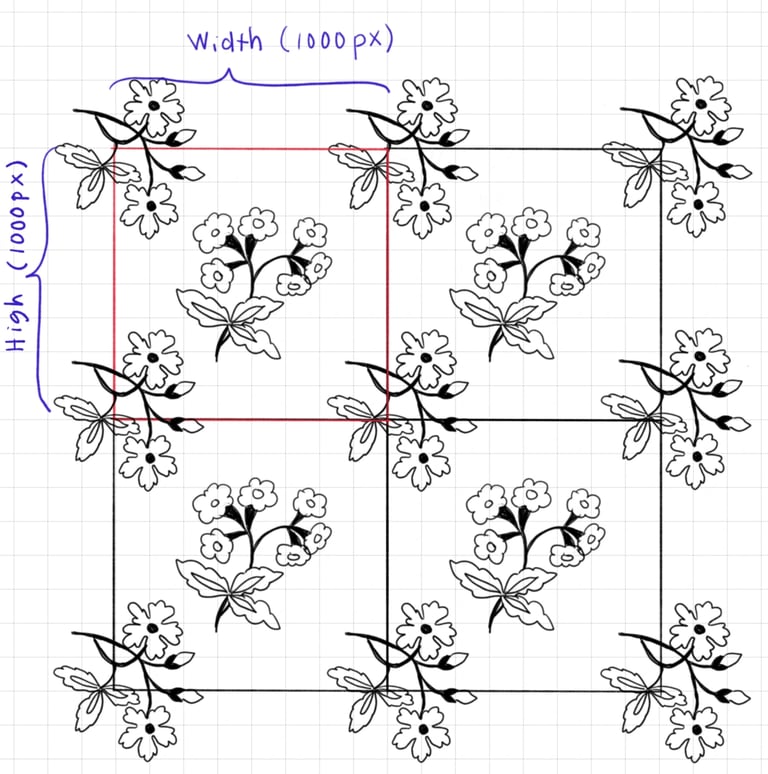
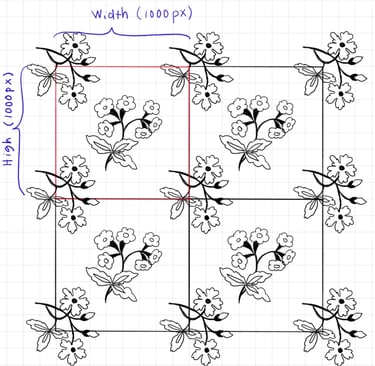
2. Half Drop Repeat
The Block Repeat is the most basic structure, often called a Straight Repeat. This layout places the repeat tiles onto a simple, straightforward grid, lining them up perfectly next to and directly below one another. This is the foundational pattern upon which many aesthetic variations are built. For example, the turn over, mirror, tossed, all over, and trailing methods are simply ways of arranging the motifs within the block to repeat themselves. Furthermore, geometric shapes like the circle, hexagon, diamond, and Ogee can be used as a template to fill the space inside the block, which is usually a square. If you look at the 17th-century design Veld van vier tegels (Tile with Grapes, Tulips, Pomegranates, Stars), you can observe a perfect block/straight arrangement. The 15th-century Italian Silk Damask features a mirror/turnover arrangement within that block structure, and the Ispahan Textile design showcases the ogee template.
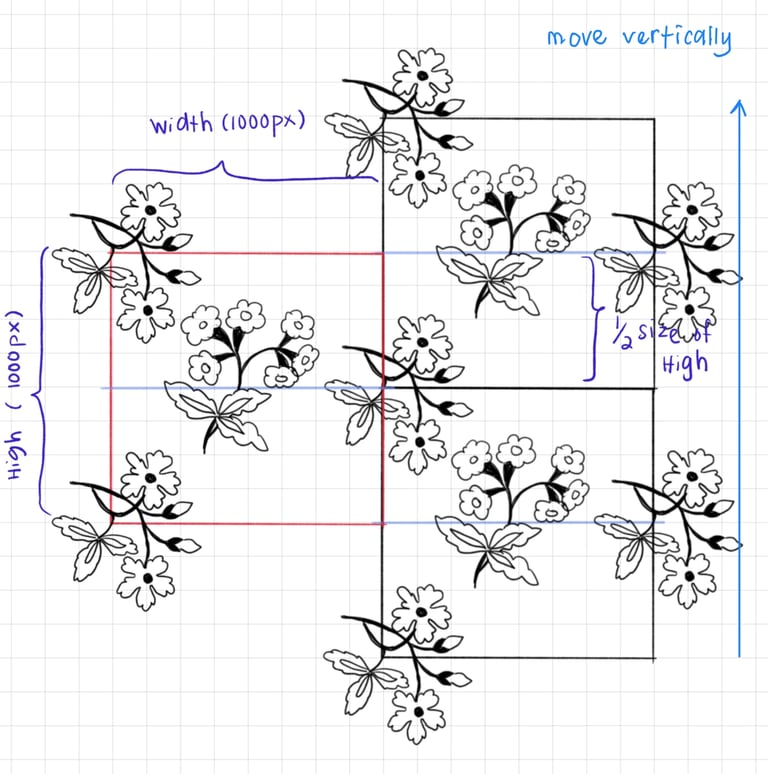
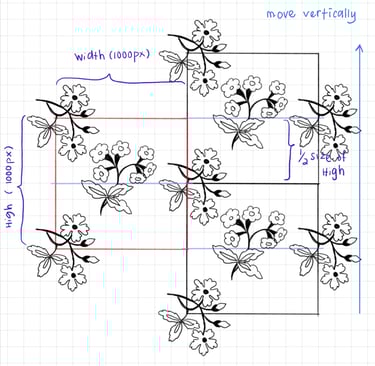
Next, we introduce a staggered effect with the half-drop repeat. This technique is designed specifically to make the repeating boundary less obvious by introducing a diagonal flow. When the pattern is repeated vertically, the subsequent row is dropped or shifted down by half the height of the repeat tile. This creates a smoother transition and often gives the final design a more dynamic or organic feel. A beautiful example of this technique is the 19th-century floral design for printed textile by Louis-Albert DuBois.
3. Brick Repeat
Finally, the Brick Repeat achieves a similar staggering effect to the half-drop, but it is applied horizontally. This structure gets its name because it mimics the layout of bricks in a wall. In the brick repeat, the subsequent horizontal tile is shifted over by half the width of the tile. This horizontal stagger is another excellent structural method for effectively hiding the edges of your blueprint. Look at John Henry Dearle’s 1896 Art Nouveau pattern, Compton, to see a clear example of this horizontal shift.


Examples of repeat pattern
This list provides famous, specific examples of public domain artwork that clearly demonstrate the various repeat techniques defined in the pattern anatomy table:
Specific Public Domain Pattern Examples by Technique
Conclusion
In summary, developing a successful continuous design depends entirely on selecting and correctly executing the appropriate underlying structure. Whether you choose the simple Block Repeat for uniformity, the Half-drop Repeat for vertical staggering, or the Brick Repeat for horizontal staggering, these three layouts provide the non-negotiable mathematical structure that allows your visual design to seamlessly repeat and extend infinitely. Remember that the various names you encounter for specific pattern types are simply formed by the techniques used to develop the specific pattern type within one of these three primary layouts. Now that you have the blueprint, start experimenting with how your motifs are arranged and balanced within these structural containers.
Types of Repeat Pattern Layout
What Is a Repeat Pattern?
So, let's define our starting point. A repeat pattern is essentially the smallest possible blueprint for a continuous design. Think of it as a single, carefully crafted square or rectangular tile. This element is intended for repetition and requires precise knowledge of its underlying structure or anatomy. Your key objective is ensuring that the resulting surface appears as one unbroken, flowing design when this single tile is duplicated and placed seamlessly edge-to-edge, sideways, and up and down. The process requires providing the underlying mathematical structure that allows the image to extend infinitely without any noticeable gaps or jarring breaks. Ultimately, whether you are utilizing a simple grid or a staggered arrangement, most pattern repeats are based on three main types. Let's explore these essential layouts.